Crumbly, savory cornbread stuffing with crisp edges and smoky bacon is the kind of side dish that disappears before the main course gets a fair shot. The cornbread stays tender in the middle, the top bakes into a golden crust, and every bite carries the kind of herby, buttery depth that makes people go back for a second spoonful before they’ve finished the first.
The key is starting with day-old cornbread so it can soak up the broth without collapsing into mush. Bacon drippings do double duty here: they brown the vegetables and carry the sage and thyme straight through the dish. The eggs help the stuffing set just enough to slice cleanly, while the oven finish gives you those crisp bits around the edges that everybody fights over.
Below, I’ve broken down the one step that keeps cornbread stuffing from turning soggy, plus a few smart swaps and storage notes so you can make it ahead without losing that crisp top.
The bacon flavor came through without making it greasy, and the top got beautifully crisp while the middle stayed moist. I baked it the full time uncovered and it sliced just like the picture.
Save this cornbread stuffing with bacon and sage for the holiday side dish with the crispest golden top.
The Reason Cornbread Stuffing Stays Crisp Instead of Turning to Mush
The biggest mistake with cornbread stuffing is treating it like bread pudding. Cornbread is softer and more fragile than cubed sandwich bread, so it needs enough moisture to hold together, but not so much that it loses its crumbly texture. The broth should coat everything evenly, not pool in the bowl. If you see liquid collecting at the bottom, the mix is already too wet.
Letting the stuffing bake covered first gives the eggs time to set the center without drying out the top. Then the uncovered finish is what gives you those browned edges and the contrast between the tender middle and the crisp surface. That two-stage bake is what keeps this dish from collapsing when it comes out of the oven.
What the Bacon, Sage, and Day-Old Cornbread Are Doing Here
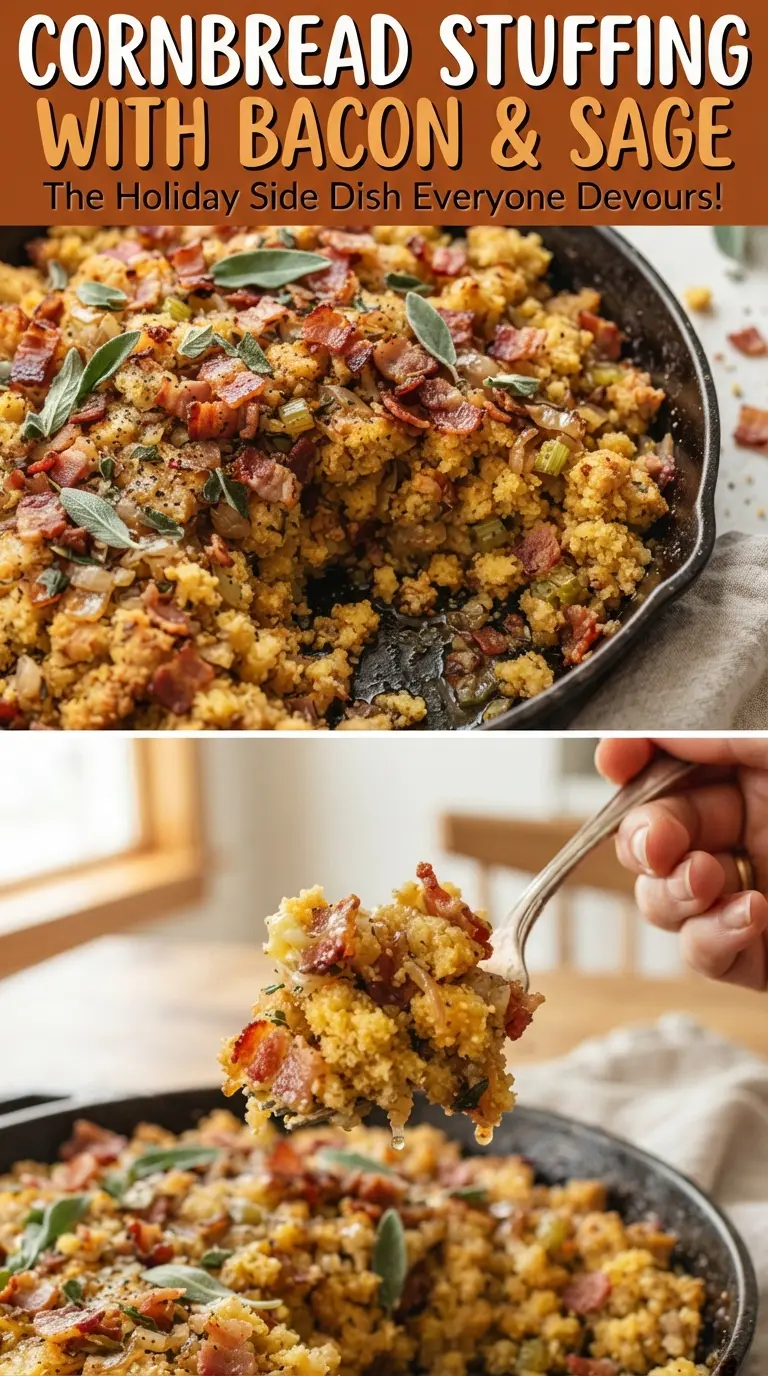
- Day-old cornbread — Fresh cornbread falls apart too fast and turns gummy once the broth goes in. Day-old cornbread has enough structure to absorb moisture and still stay in chunks. If yours is still very soft, spread it on a sheet pan and dry it in a 300°F oven for 10 to 15 minutes.
- Bacon — This gives you salt, smoke, and rendered fat for the vegetables. Thick-cut bacon works fine, but standard bacon gives better distribution because it crumbles more evenly through the dish. Keep the drippings in the pan; that’s where the flavor base starts.
- Fresh sage — Fresh sage is the difference between a stuffing that tastes flat and one that tastes like it belongs on a holiday table. Dried sage works in a pinch, but use half the amount because it’s more concentrated and less floral.
- Chicken broth — Use a broth that tastes good on its own. A weak broth makes the whole dish bland, and no amount of butter fixes that after the fact. Warm broth blends in more easily and helps the stuffing hydrate evenly.
- Eggs — These are what help the stuffing hold together once baked. Skip them and the center stays loose and crumbly in an unpleasant way. Whisk them into the broth before pouring so they distribute evenly instead of streaking through the pan.
Getting the Texture Right From the Pan to the Oven
Crisping the Bacon First
Cook the bacon until it’s crisp enough to crumble but not burned. You want enough rendered fat left behind to cook the onion and celery, because that fat carries flavor into the vegetables. If the bacon is undercooked, it turns chewy in the stuffing instead of staying crisp. Remove it from the pan before adding the butter so it doesn’t overcook while you build the base.
Softening the Aromatics
Cook the onion and celery until the onion turns translucent and the celery loses its raw edge, about 8 minutes. This step matters because the vegetables won’t soften much more once they’re mixed into the cornbread. Stir in the garlic, sage, and thyme at the end so they bloom in the hot fat without scorching. If the garlic goes in too early, it can turn bitter before the stuffing ever reaches the oven.
Moistening Without Drowning
Pour the broth and eggs over the cornbread mixture a little at a time, then toss gently. Stop as soon as everything looks evenly moistened and the cornbread still holds its shape. You want damp crumbs, not a batter-like mixture. If it looks soupy in the bowl, the finished stuffing will bake up dense and pasty.
Baking for a Set Center and Crisp Top
Spread the mixture into a greased 9×13-inch dish and cover it tightly with foil for the first part of baking. That covered bake lets the center firm up before the surface dries out. Uncover it for the last stretch so the top can brown and the edges can turn crunchy. The stuffing is done when the top is deeply golden and the center feels set when you press it lightly.
How to Adapt This Stuffing for Different Tables
Make It Dairy-Free
Swap the butter for a neutral oil or plant-based butter and keep the bacon drippings if you’re using bacon. The texture stays close to the original, though the flavor loses a little of that rich buttery roundness. If you use plant-based butter, choose one that browns well so the vegetables still pick up some depth.
Make It Gluten-Free
This works naturally if your cornbread is gluten-free and the broth is certified gluten-free. The texture can be a touch more delicate, so handle the crumbs gently when mixing. Drying the cornbread a little longer before assembling helps it keep its shape.
Use Turkey Bacon or Skip the Bacon Entirely
Turkey bacon will give you less fat and a milder smoky note, so add an extra tablespoon of butter to keep the vegetable base flavorful. For a vegetarian version, skip the bacon and use butter plus a tablespoon of olive oil, then add a pinch of smoked paprika if you want some of that savory backbone back in the dish.
Storage and Reheating
- Refrigerator: Store leftovers covered for up to 4 days. The top softens a bit in the fridge, but the flavor holds well.
- Freezer: It freezes well if you wrap it tightly after it cools. Freeze in portions for easier reheating; the texture is best within 2 months.
- Reheating: Reheat covered in a 325°F oven until hot, then uncover for the last few minutes to bring back some crispness. The biggest mistake is microwaving it straight from the fridge, which makes the cornbread dense instead of tender.
Questions I Get Asked About This Recipe

Cornbread Stuffing with Bacon and Sage
Ingredients
Equipment
Method
- Preheat the oven to 350F and grease a 9x13-inch baking dish.
- Cook the bacon until crisp, then remove it and leave the drippings in the pan.
- Add the butter, onion, and celery, then cook for 8 minutes until soft.
- Stir in the garlic, sage, and thyme and cook briefly just until fragrant.
- Toss the crumbled cornbread with the vegetables and bacon in a large bowl.
- Whisk the chicken broth, eggs, salt, and black pepper, then pour over and gently toss until moistened.
- Spread the mixture into the greased dish, cover with foil, and bake for 25 minutes at 350F.
- Uncover and bake for 20 to 25 minutes at 350F until golden and crisp on top, with a brown, set edge around the dish.